Anime colour theory
Anime color theory
Disclaimer
Due to copyright policies, I will not be able to show direct images of the characters discussed in this article, but all characters and series will be cited and linked through the article.
If you’re a new reader and you’re interested in reading more about this topic, I suggest you start by reading the colour psychology articles, and when you’re finished with them, return here and you’ll understand more about this topic. Now we can really start the article.
Traditional colors
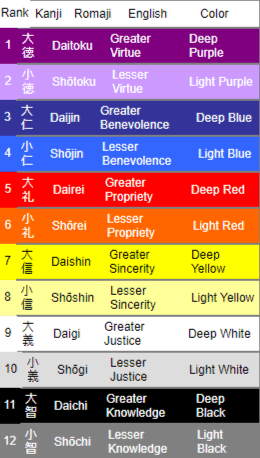
As we usually do to deeply understand the meanings behind a colour, we need to study the history behind it. The tradition of Japanese colours was probably born in 603, when Prince Shotoku established the first twelve hues for the rank system in Japan. The different colours had different social levels and deeply influenced the perception of colours in the society. Here is an image that shows the different colours and ranks. As we’ll see, after the colour purple is associated with the higher ranks, so royalty.
Five elements
Although the historical culture, Prince Shotoku designed the rank based on the five Chinese elements (fire, wind, earth, water and void). These elements are usually related in anime; for example, in Naruto there are five villages and five types of chakra.
In general, if you think about it, most shonen present some element-based powers, where usually the most powerful or important are the ones connected with the five elements. For this we can think of another anime from the big 3, Bleach. In Bleach the power of fire is wielded by just one character, one of the most powerful in the verse, Shigekuni Yamamoto Genryūsai.

Kimono’s colors
In addition, there are then a lot of different colour codes connected with the culture about kimono. Here is a table with the most common theme and colour for each month.

Hair in anime colors
When we talk about visual media, the most important aspect is design. In anime, eyes and hair play a fundamental role in the creation of an expectation about the character and his role in the story. Although we normally can find different hairstyles, here are the most iconic:
- Mother’s sided ponytail
- Normal ponytail
- Twintail
- Spiky hair
- Hime cut
- Ojou ringlets
- Odango Buns
- Pompadour
- Hair antenna
- Ahoge
- Bald
The side ponytail
The side ponytail is usually used to represent mothers in anime. Sadly this hairstyle is often referred to as the “dead-mother style” too. The reason for this change of name is because usually the fandom spots this specific hairstyle on characters that at the start or during the series die, and usually all of them are mothers. Some examples (with no big spoilers) are Trisha Elric (Fullmetal Alchemist) and Carla Yeager (Attack on Titan). The classical ponytail, instead, usually is used to represent a ready personality, often ready for action. An example of this is Yoko (Gurren Lagann).

Twintail
Then we reach the twintail. This hairstyle is usually used to represent childish characters. Sometimes this characteristic is used to create a more complex character. For example, Mine (Akame Ga Kill) uses twintails to represent a childish character; in addition, this personality fuses with the seriousness of the anime, creating a character that is capable of shifting from these two opposite ideals. To conclude, this character fuses with the colour of hair that adds value to the hairstyle storyline.

Hime cut
In addition to female hairstyles, we have the hime cut. This hairstyle is usually used to represent characters with royal implications or a royal attitude. Although the hairstyle can have many variations depending on the designer, the style is derived from the Heian period when Japan started to change its style from the Chinese influence. During that period the nobles started having long straight black hair. This style is used on Chi-Chi (Dragon Ball).

Spiky hair
The spiky hair representatives of male characters use spikes to represent the powerful personality of the character. Often we can see that most aggressive and determined characters tend to have spiky hair in anime. A common example of this is Katsuki Bakugo (My Hero Academia). The spikiness of hair is used even for calmer personalities like Izuku Midoriya from the same series. These two characters represent two opposite personalities, and so does their hair. Midoriya is represented with “calmer” hair because of his peaceful personality; Bakugo is the opposite.

Ojou ringlets
Although the hime cut usually represents royalty, the ojou ringlets represent prissy snobs. A common example of this style is Elizabeth Midford (Black Butler).

Odango buns
Although the Hime cut tries to diversify from Chinese culture, the presence of this one is still present. The Odango buns are a variation of the twintail popular in China. In anime this hairstyle represents or hints at a Chinese origin of the character in question. An example of this is May Chang (Fullmetal Alchemist Brotherhood), who has odango buns.

Pompadour
Madame de Pompadour of King Louis the 15th’s court invented the pompadour hairstyle. Imported to Japan by Americans during the rebuilding after WW2. This style during the 60s became a symbol of rebellion, and for this reason, it became popular among the young generation. Still used to this day, in anime it represents the rebellious characters with a golden heart; a quick example is Chiharu Shiba (Baki), a gangster with a strong moral code, or we can think about. Another example is Ryu Umemiya (Shaman King).

Hair antenna and ahoge
The Ahoge style literally means “foolish hair”. Visually, it is a single cowlick, normally added to other hairstyles mentioned before. When the cowlick becomes more than one, the style takes the name of hair antenna. The simplicity of this style is usually used for secondary characters of protagonists who are naive or silly. Even though the hairstyle doesn’t have a direct cultural connection, the style is used for Edward Elric (Fullmetal Alchemist Brotherhood) to smooth the character design. In this specific case the ahoge suggests innocence.

And no hair?
The bald look instead is not popular in anime because hairstyles, like eyes, are ways to represent the personality of characters. The absence of this important feature is a feature itself. The absence of hair usually represents characters with strong bodies and heated personalities; some examples are Saitama (One Punch Man), a typical example of strength, and Ikkaku Madarame (Bleach).

Eyes in anime
Another important aspect in anime is eyes. For Japanese culture the eyes represent the real soul of a person, so it’s not a coincidence that eyes have such an importance in anime. Eyes in anime take different styles, but the most common when we think about anime are big colourful eyes. Usually we see innocent or good characters represented with big eyes. On the other hand, the enemies or bad guys usually tend to have smaller eyes.
Another rule added to this general design pattern is the colour of the pupil. As a matter of fact, when the pupil is black, it is usually used to represent an evil or possessed character.
Why anime colour?




Thank you all for reading this article; see you in the next :).
For any information, here are all my personal links:
The sources used for this article:
- www.japan-culture.info
- www.tofugu.com
- smt.blogs.com
- Traditional colors of Japan
- wikipedia
- printsofjapan
- musubikiln.com
- busuu.com
- gaia-road.com
- color-meanings.com
- chopa.com
- polinacouture.com
- printsofjapan
- watashi to tokyo
- tvtropes.org
- hinodereviews.wordpress.com
- animanga.fandom.com
- Why hair in anime? (Get in, robot.)
- Why eyes in anime? (Get in, robot.)
- www.cbr.com
- www.campus.sg
- https://naruto.fandom.com/wiki/Chakra
